


Why Brands That Use Two Agencies for Branding and Packaging Always Pay More and Get Less


It sounds sensible on paper.
One agency builds the brand. Another designs the packaging. Each specialises in what they do best. The handoff happens via a brand guidelines document. Everyone stays in their lane.
In practice, this model consistently produces the same outcome for founders across every market more revisions, longer timelines, higher combined costs, and packaging that looks like it belongs to a different brand from the identity it was built on.
At Suramya, we work with brands across India, the UAE, the US and the UK that have previously tried both models. The pattern is consistent regardless of geography. Brands that brief strategy and visual identity to one agency and packaging to another almost always come to us to fix the gap. Brands that work with one integrated studio almost never need that conversation.
This post explains exactly why and what to look for when evaluating whether an agency can genuinely handle both.
The Real Problems With Using Two Agencies

Problem 1 — The Brief Translation Tax
Every brief that passes from one agency to another loses something. Strategic intent. Emotional nuance. The reasoning behind a visual decision that seemed obvious to the brand team but reads as arbitrary to a packaging agency receiving it on paper.
A brand guidelines document captures what the brand looks like. It cannot capture why specific decisions were made — the strategic logic, the category insight, the consumer psychology that made a colour choice or typography decision the right one for this brand in this market.
The packaging agency receives the what. They make their best interpretation of the why. And that interpretation is almost always slightly off — not wrong enough to catch immediately, but wrong enough to matter when the packaging is on shelf next to a competitor.
Most founders experience this as an unexplained feeling that the packaging and the brand identity don't quite belong together. They cannot pinpoint the specific disconnect. That is the brief translation tax — diffuse, invisible, and consistently expensive.
Problem 2 — Two Accountability Structures, One Brand Problem

When branding and packaging are handled by separate agencies, every problem that arises has two possible owners and both have an incentive to assign it to the other.
The packaging doesn't feel premium enough. Is that an identity problem or an execution problem? The typography hierarchy isn't landing on the front panel. Is that a brand guidelines problem or a packaging design problem? The variant range is becoming visually incoherent as new SKUs launch. Is that the brand agency's job to fix or the packaging agency's job to fix?
These conversations consume founder bandwidth, create delays and generate resentment on both sides — without producing a solution, because the structure makes it genuinely unclear who is responsible.
With one integrated team, the question does not arise. One team owns the strategy. One team owns the identity. One team owns the packaging. One team owns the problem when something does not work.
Working with two agencies and feeling the friction?
Book a 20-minute consultation — we'll tell you
honestly whether integration would change your outcome.
Book a Free Consultation → suramya.co/contact
Problem 3 — Packaging Realities Are Invisible During Brand Development

A packaging designer working from a finished brand guidelines document is solving a problem the brand agency never had to face: how does this identity actually behave on a 50mm label on a curved glass bottle, under retail fluorescent lighting, surrounded by 40 competitors?
Colours behave differently on different substrates. Typography that looks precise on screen becomes muddy on uncoated kraft paper. A graphic language that is distinctive as a pattern becomes cluttered when applied to a 25g sachet front panel at actual production scale.
When the brand identity is developed in isolation from packaging constraints, these problems surface after the identity is approved and the packaging brief is written — which means fixing them requires either compromising the packaging or revising the identity. Both outcomes cost money and time that would not have been spent if the constraints had been considered during brand development.
An integrated agency has these conversations once, during strategy — not twice, as a rework problem after the fact.
Problem 4 — The Brief Never Ends When You Run Two Agencies
Managing two agencies on behalf of one brand is a full-time job that nobody signs up for explicitly but every founder who tries this model ends up doing.
Two briefing calls for every new product launch. Two sets of revisions to consolidate and compare. Two approval chains to run in parallel. Two cost conversations to have when something needs to change. Two separate timelines to coordinate so neither agency is blocked waiting for the other.
The combined project management overhead of running two agencies on one brand consistently costs more in founder time than the cost difference between the agencies. Most founders only recognise this after experiencing it — by which point the brand is already in market.
Problem 5 — Visual Systems Cannot Be Documented Fully Enough for Handoff
Brand guidelines are a compression of a creative process. The document captures the outputs of that process — logos, colours, typefaces, graphic devices — but not the thinking that produced them.
The thinking includes: why this specific green rather than any other green in this range. Why the logo sits in this specific quadrant of the front panel rather than centred. Why the hierarchy on the back panel is structured the way it is. Why the hero visual is placed at this scale and not larger.
These micro-decisions add up to a coherent brand. When a packaging agency makes their own interpretations of all of them based on the guidelines document rather than the strategic conversation — the result is a packaging execution that is technically compliant and visually discordant.
The gap is almost invisible in isolation. It becomes obvious when a consumer encounters the brand across multiple touchpoints simultaneously, or when a new SKU launches and the incoherence compounds.
What Integration Between Branding and Packaging Actually Looks Like
"We do branding and packaging" is something many agencies say. Fewer deliver it. Even fewer deliver it as genuine integration where the strategic thinking that drives brand identity directly governs every packaging decision, without a handoff, a translation, or an interpretation gap.
Here is what genuine integration looks like in practice:
One Brief, Not Two
Integration begins with a single brief that governs everything. The brand's positioning, target consumer, competitive category analysis, visual direction and channel strategy are defined once and that single definition drives both brand identity and packaging design.
There is no separate packaging brief written later. There is no translation of one agency's strategic output into another agency's creative input. The brand strategy informs every packaging decision directly, because the same team holds both.
Packaging Constraints Shape the Identity — Not the Other Way Around
In an integrated process, the packaging brief is part of the brand development process not downstream from it.
How does this identity need to perform on a 28mm label? Can this graphic language work at sachet scale? Does this colour palette hold up on uncoated kraft at 300dpi? Will this typography hierarchy survive flexographic printing without losing legibility on the secondary text?
These constraints are considered during brand strategy, which means the identity that emerges is one that can actually be executed across every packaging format the brand needs without compromise.
SKU Extensions Are Governed by System Rules, Not New Briefs
A genuinely integrated branding and packaging process produces a system not a design. The difference matters enormously at scale.
A system has rules: how variant differentiation is handled visually without breaking brand recognition. How a new flavour is introduced into the range. How a pack size extension is executed consistently with the existing hierarchy. How a market-specific variant (different language, different regulatory requirements, different format) is produced without losing the visual identity.
When these rules are owned by the team that built the brand, every SKU extension is a 2-week project. When they have to be interpreted from a guidelines document by a packaging agency that did not build the brand, every SKU extension is a full project that risks introducing new inconsistencies.
📦 Launching more than 3 SKUs this year?
See how we've built packaging systems for founder-led
brands across India, UAE and the US.
See Our Work → suramya.co/work
One Team Catches Problems Before They Become Expensive
Brand-packaging integration means the strategic and design team are in the same room (virtual or physical) when a problem arises. A print proof that shows a colour shift gets addressed by the same person who specified the colour — who knows exactly what the correction needs to be and why.
A new retail channel's specific packaging requirements get interpreted by the team that already understands the brand's visual architecture not briefed as a new project to a separate agency.
A regulatory compliance requirement that affects the front panel hierarchy gets resolved by the team that designed the hierarchy not routed between agencies as an urgent revision on a tight timeline.
The Scenarios Where Two Agencies Specifically Fail Founders
Founder-Led Brands Scaling Across Multiple Retail Channels
A consumer brand launching today does not launch into one channel. It launches into retail, ecommerce and quick delivery platforms simultaneously — each with different visual requirements, different information hierarchies and different definitions of what makes packaging stand out.

Channel | What packaging must do |
Supermarket / grocery retail | Brand recognition at browsing distance, clear shelf block |
Modern trade / department stores | Shelf-facing hierarchy, clear variant navigation |
Amazon / ecommerce | Hero image performance at thumbnail scale |
Quick delivery platforms | Brand name readable in under 2 seconds at app scale |
DTC / unboxing | Secondary packaging and inserts as brand touchpoints |
Whole Foods / Sprouts / Waitrose | Premium shelf aesthetic, ingredient transparency |
A packaging agency working from a brief can execute for one of these channels effectively. Designing intelligently for all of them simultaneously — with the brand strategy as the anchor — requires the same team to own both the positioning and the packaging.
Brands Scaling From 3 to 30 SKUs
Most consumer brands launch with 3-5 SKUs and scale to 20-30 within 2-3 years. The packaging system that holds a 5-SKU range together is manageable with guidelines and a good brief. The packaging system that holds a 25-SKU range together — across multiple flavour variants, size variants, format variants and market variants — must be owned by one team with continuous memory of every decision made since the brand was built.
Every new SKU briefed to a separate packaging agency introduces the risk of a small visual decision that is technically compliant but systematically wrong. At 25 SKUs, those small decisions compound into visible incoherence on the shelf block that no amount of individual SKU quality can undo.
Wellness and Natural Product Brands Where Trust Is the Primary Purchase Driver
In wellness, natural and functional product categories — whether you're selling in Dubai, London or New York — the coherence between brand identity and packaging is a trust signal. A consumer evaluating a supplement or a wellness formulation for the first time is using every visual cue available to assess whether this brand is credible.
A packaging execution that is slightly off from the brand identity registers subconsciously as a quality concern. Not a major alarm. Just a quiet reduction in confidence that shows up as a slightly lower conversion rate that nobody can explain.
This is the kind of problem that an integrated branding and packaging team prevents by default and that a split-agency model produces by default.
Premium and Lifestyle Brands Competing on Sensory Experience
Premium packaging depends on the integration of material choices, finish decisions, structural design and visual identity into a single sensory experience. The haptic weight of the bottle communicates the same thing the visual identity communicates. The matte soft-touch finish expresses the same brand personality as the typography.
When branding and packaging are split, these decisions are made by separate teams with separate creative frameworks. The result can be technically excellent on both sides — and still feel slightly incoherent as an integrated experience. The visual says premium. The material says slightly less so. The consumer picks up the disconnect without being able to name it.
D2C Founders Building Across Markets
Founders building brands that need to work in more than one market — say, a wellness brand launching in both the US and the UAE simultaneously, or a food brand moving from domestic retail into export — face an additional layer of complexity. Packaging for different markets often requires different regulatory layouts, different language requirements and sometimes different visual hierarchies to match local retail conventions.
When a single integrated team owns both brand identity and packaging, these market adaptations are executed as system variations — derived from the same strategic foundation, governed by the same rules. When two agencies are involved, every market adaptation becomes a three-way coordination challenge: brand agency, packaging agency and the founder in the middle.
How to Evaluate Whether an Agency Genuinely Delivers Both ?
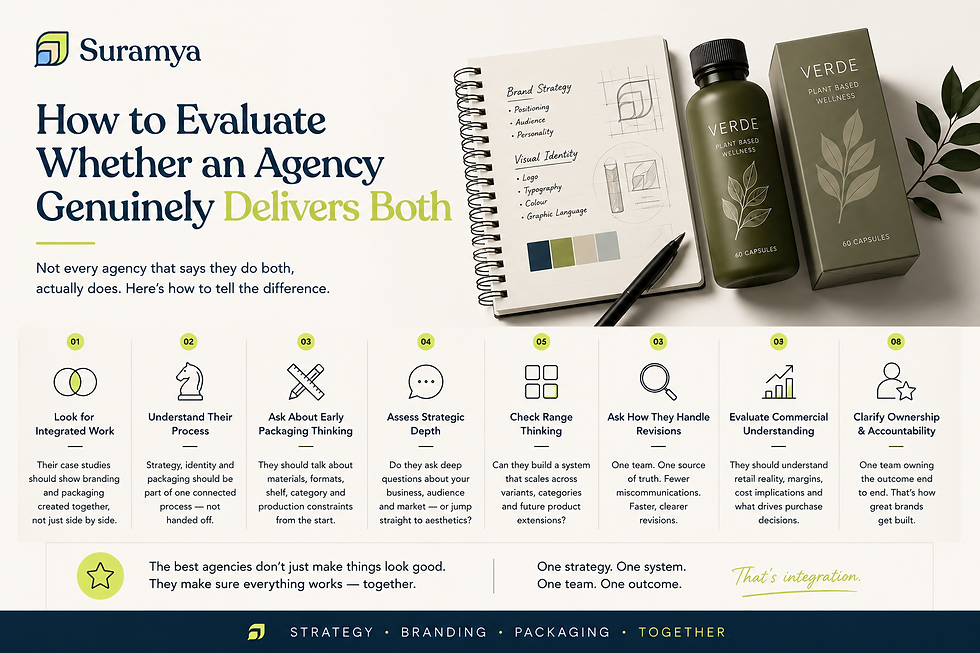
Many agencies offer branding and packaging. Fewer do it as genuine integration. Here is how to tell the difference before you sign anything.
Ask for the reasoning, not just the portfolio Ask the agency to walk you through a project from strategy to final production. A genuinely integrated agency can explain every design decision in terms of the strategic brief that produced it. Why this colour? Because the positioning defined the brand as [X] and this colour communicates [Y] specifically in the [Z] category. That level of reasoning should be continuous from brand identity through to every panel of the packaging.
Ask who specifically does the packaging work Some agencies pitch branding and packaging as an integrated offering but execute them through separate internal teams or external partners. Ask specifically who will design the packaging, and whether they are the same people who will build the brand strategy. The closer those teams are — ideally the same people — the more genuine the integration.
Look for packaging that exists at retail, not just in mockups Integrated packaging work should be visible on actual shelves — in retail stores, on ecommerce platforms, in the markets the agency claims to serve. A portfolio of photorealistic mockups can look excellent and conceal significant execution problems. Ask to see products that are in market today.
Ask about the SKU extension process How does a new variant get designed? Is it a new brief or an application of existing system rules? A genuinely integrated agency has a defined, efficient process for SKU extensions — because the system rules were established during the original brand development and are held by the same team.
Ready to brief a branding and packaging project?
Here's what working with Suramya looks like from
first call to final production-ready files.
Explore Our Branding Services → suramya.co/branding
Why Suramya Is Built for Both
At Suramya, branding and packaging have always been one process — not two services.
Our brand strategy work defines positioning, consumer, competitive territory and creative direction before any design begins. The packaging constraints for the brand's specific channels — retail, ecommerce, quick delivery, DTC — are part of that strategy conversation, not a downstream consideration.
The same team that develops your brand identity designs your packaging. The same strategic brief that defines your visual identity governs your front panel hierarchy, your variant colour architecture, your back panel information structure and your unboxing experience.
This is not a workflow efficiency. It is the reason our clients' packaging and brand identities feel like they belong together — because they were built from the same thinking, by the same people, governed by the same brief.
We work with consumer brands, CPG startups and founder-led businesses across India, the UAE, the US and the UK — at every stage from first SKU launch to portfolio redesign.
If your branding and packaging are currently split across two agencies — or if you're about to brief a new brand project and want to avoid that situation — book a free consultation and let's talk about how integration changes the outcome.
Book a free consultation → suramya.co/contact
FAQs
Q: Is it better to use one agency for branding and packaging or separate agencies? A: One integrated agency consistently produces more coherent, commercially effective results for consumer and CPG brands. Split agencies introduce brief translation gaps, dual accountability structures and compounding visual inconsistencies that cost more to fix than they saved by specialising.
Q: What does a branding and packaging design agency do differently from a branding-only agency?
A: A branding and packaging agency develops the brand strategy and visual identity with packaging constraints already in mind — ensuring the identity can be executed coherently across every format the brand needs. A branding-only agency hands off to a packaging agency, which then interprets the guidelines without the strategic context behind them.
Q: How do I know if an agency genuinely integrates branding and packaging or just offers both separately?
A: Ask them to walk you through a project from strategy to final packaging. A genuinely integrated agency explains the strategic reasoning behind every packaging decision. Ask who specifically does the packaging work and whether they are the same people who develop the brand strategy.
Q: Why do founder-led and DTC brands specifically benefit from integrated branding and packaging?
A: Founders building across multiple channels and markets simultaneously — retail, ecommerce, quick delivery, DTC — need packaging that works everywhere from a single strategic brief. An integrated agency makes this possible without the coordination overhead of managing two separate teams.
Q: How much does it cost to use one agency for both branding and packaging?
A: At Suramya, every project is scoped individually based on the number of SKUs, channels and complexity. The combined investment for integrated branding and packaging is typically lower than the total cost of two separate agencies because strategy is defined once, revisions are reduced and SKU extensions are significantly faster. Book a free consultation for a clear scope and quote.
Related reading:
→ Branding services at Suramya suramya.co/branding
→ Packaging design services suramya.co/packaging-design-services
→ Brand strategy suramya.co/brand-strategy
→ CPG and FMCG packaging suramya.co/industries/fmcg
Suramya is a brand identity and packaging design studio working with consumer brands, CPG startups and founder-led businesses across India, the UAE, the US and the UK.


Comments