


Your Australian Beauty Launch Could Be Pulled From Shelves : Here's Every Packaging Compliance Requirement You Need to Meet


Most beauty brands that fail their Australian launch do not fail because their product is poor. They fail because their packaging is non-compliant, and they discover this after the product is already in market.
A missing INCI ingredient listing. A therapeutic claim on a skincare label that the TGA has not approved. An incorrect net weight statement. A batch number system that does not satisfy ACCC traceability requirements. Any of these, individually, can trigger a product recall, a regulator enforcement action, or a market ban.
Getting it right from day one is significantly easier than fixing a recall or reprint later. Reprinting packaging after a product is in market costs time, money and retailer relationships that take years to rebuild. The brands that navigate Australian compliance successfully treat it as a design brief from day one, not a checklist to be completed after the creative work is finished.
This guide covers every packaging requirement an Australian beauty brand must meet, across the three regulatory bodies that govern the category, in the sequence that makes it easiest to implement correctly.
The Three Regulatory Bodies Every Australian Beauty Brand Must Understand

Regulatory bodies such as the Australian Competition and Consumer Commission (ACCC), the Therapeutic Goods Administration (TGA), and the Australian Industrial Chemicals Introduction Scheme (AICIS) oversee cosmetic products in Australia. Each covers a different dimension of compliance. Understanding which body governs which aspect of your product is the essential starting point.
Regulatory Body | What It Governs | Key Requirement |
ACCC | Consumer claims, labelling accuracy, misleading conduct | Consumer Goods (Cosmetics) Information Standard 2020 |
TGA | Therapeutic claims, sunscreens, medicines | AUST L / AUST R registration number where applicable |
AICIS | Chemical ingredients in formulations | Australian Inventory of Industrial Chemicals (AIIC) compliance |
NMI | Net weight and measurement accuracy | Trade Measurement Act compliance |
ACCC / ACL | Country of origin claims, environmental claims | Country of Origin Food Labelling Information Standard |
The ACCC, Your Primary Packaging Regulator
The primary law is the Consumer Goods (Cosmetics) Information Standard 2020, which is enforced under the Australian Consumer Law (ACL) by the ACCC.
This standard governs what must appear on every cosmetic product sold in Australia, regardless of where it is manufactured. It applies to imported brands entering the Australian market just as it applies to domestic manufacturers.
The TGA, When Cosmetics Become Therapeutic Goods
The ACCC regulates cosmetic labelling and general claims under the ACL. However, if your claims stray into therapeutic territory, the TGA takes over regulatory authority.
This distinction, cosmetic versus therapeutic good, is the most consequential compliance decision a beauty brand makes. It determines the entire regulatory pathway your product must follow and the labelling requirements that apply to it.
AICIS, Chemical Ingredients Compliance
Under the Industrial Chemicals Act 2019, all ingredients must comply with the Australian Inventory of Industrial Chemicals (AIIC). Although pre-market approval is not always required, manufacturers are legally responsible for product safety.
AICIS requires ingredient labelling using International Nomenclature of Cosmetic Ingredients (INCI) names, listed in descending order of quantity.
Building a beauty brand for the Australian market and want packaging that meets compliance from day one? Book a free consultation, we design with regulatory requirements built into the brief, not added as an afterthought.
[Book your brand strategy call → suramya.co/contact]
Cosmetic vs Therapeutic Good, The Decision That Changes Everything
Before any packaging is designed, a beauty brand entering Australia must answer one question with precision: is this product a cosmetic or a therapeutic good?
Advertisements must not create unrealistic expectations, misuse testimonials, or imply that a registered professional is performing a procedure when they are not.
The distinction is determined by the claims made, not by the product's formulation.
If Your Product Claims To... | It Is Classified As... | Regulated By... |
Cleanse, moisturise, colour, perfume | Cosmetic | ACCC / Consumer Goods Standard |
Treat acne, reduce inflammation, alter skin function | Therapeutic good | TGA |
Protect against UV radiation | Therapeutic good (sunscreen) | TGA |
Treat eczema, psoriasis, dermatitis | Therapeutic good | TGA |
Reduce wrinkles (cosmetic claim) | Cosmetic | ACCC |
Stimulate collagen production (functional claim) | Therapeutic good | TGA |
Crucial exception: sunscreens. Sunscreens, when making claims about protection against UV radiation, are considered therapeutic goods and are regulated by the TGA, not the Cosmetics Standard, due to their physiological protection claims.
Do not make therapeutic claims (e.g., "treats eczema") unless the product is appropriately listed or registered with the TGA. Claims must align with the product's listing or registration, you cannot "over-claim" beyond approved indications.
The practical consequence: A moisturiser labelled "deeply hydrates skin" is a cosmetic. The same moisturiser labelled "repairs the skin barrier" may be a therapeutic good. A single word change in your packaging copy can move your product from one regulatory category to another. This is not a copywriting decision. It is a regulatory decision that must be made deliberately and reviewed by someone with compliance expertise before final artwork is approved.
Mandatory Label Elements, The Consumer Goods (Cosmetics) Information Standard 2020

Every cosmetic product sold in Australia must include the following elements on its packaging. Missing any one of these is a non-compliance breach regardless of how premium the product is or how reputable the brand.
1. Product Name and Function
The product must be clearly identified by name. If the name alone does not make the product's function obvious to a consumer, for example, a brand name that does not indicate whether the product is a cleanser, serum, or moisturiser, a function description must be included.
2. Name and Address of the Responsible Supplier
Cosmetic labels in Australia must follow a set of clear rules designed to protect consumers and ensure product transparency.
The packaging must identify who is responsible for placing the product in the Australian market. For international brands, this is typically the Australian importer or distributor, not just the overseas manufacturer. This must be a physical address, not a PO box.
Supplier Type | What Must Appear |
Australian manufacturer | Company name + Australian address |
International brand with Australian distributor | Distributor name + Australian address |
International brand selling direct | Australian registered entity name + address |
3. Country of Origin
In Australia, your packaging and labels are regulated primarily under the Australian Consumer Law (ACL), administered by the ACCC. The ACL prohibits misleading or deceptive conduct, requires accurate representations and sets rules around pricing, warranties and product information.
Country of origin claims in Australia are subject to specific rules under the ACL. "Made in Australia" and "Product of Australia" are legally distinct claims with different thresholds. "Made in Australia" requires that the product be substantially transformed in Australia. "Product of Australia" requires that all significant ingredients or components originate in Australia and all production steps occur in Australia.
Incorrect country of origin claims are one of the most frequently actioned ACCC enforcement areas.
4. Net Weight or Volume
The PDP must show the net weight or volume of the cosmetic. This tells consumers exactly how much product they are purchasing and prevents misleading claims about quantity.
Net content must be stated in metric units, grams or millilitres, and must be accurate at the time of sale. Net weight compliance falls under the National Measurement Institute's Trade Measurement legislation. Products that are underweight relative to the stated net content are a specific enforcement target.
5. Ingredient List, INCI Format, Descending Order
You must use the International Nomenclature of Cosmetic Ingredients (INCI) name or the common English name. Using INCI is highly recommended for clarity and global compliance.
The ingredient list must:
Use INCI names or accepted common English names
Be listed in descending order of concentration (highest concentration first)
Include all ingredients including water, fragrance, and colorants
Be legible, minimum font size requirements apply
Ingredient Concentration | Order Requirement |
All ingredients above 1% | Listed in descending order by concentration |
All ingredients at 1% or below | Can be listed in any order after the above-1% ingredients |
Colorants regardless of concentration | Can be listed last in any order |
Are travel-sized or sample products exempt from ingredient labelling? Products sold commercially must list ingredients. The exemption only relates to the placement of the list on small containers, requiring it to be displayed prominently nearby. Free samples and testers are exempt from the standard.
6. Batch Number
According to the ACCC, batch numbers play an essential role in traceability and recall processes, allowing companies to efficiently identify and recall only the affected products in case of defects or issues. This minimises the impact on the brand and ensures consumer safety. An example of a batch number might be "Batch No: 2024A0123."
The batch number system does not need to follow a specific format, but it must exist, it must be consistent, and it must enable the brand to identify the specific production batch a recalled unit came from. An inconsistent or absent batch number system is a significant compliance risk in the event of an adverse reaction or product safety issue.
7. Expiry Date or Period After Opening (PAO)
According to the Consumer Goods (Cosmetics) Information Standard 2020, this information, which can be labelled as "Best Before" or "Use By" date, ensures that consumers use the product within its effective period, reducing the risk of adverse effects from expired products. In addition to the expiry date, the Period After Opening (PAO) symbol is also essential.
Products with a shelf life of 30 months or less require a "Best Before" or "Use By" date.
Products with a shelf life exceeding 30 months require the Period After Opening (PAO) symbol, the open jar icon, indicating how long the product remains safe after first use.
Product Shelf Life | Required Indicator |
30 months or less | Best Before / Use By date |
More than 30 months | PAO symbol (open jar icon with duration, e.g., "12M") |
Both indicators present | Acceptable, provides maximum consumer information |
8. Warnings and Safety Statements
Adding warning statements to labels is a cosmetic label requirement in Australia. Warnings must be understandable, as they give a better understanding of how to use the product. Furthermore, warning statements help manufacturers meet safety standards set by the Therapeutic Goods Administration (TGA).
Specific warning statements are mandatory for certain ingredients and product types:
Ingredient / Product Type | Mandatory Warning |
Products containing AHAs (alpha hydroxy acids) | "Contains AHAs. Use sunscreen, see directions." |
Products with high concentration essential oils | Specific dilution / avoid contact warnings |
Aerosol products | Flammability and inhalation warnings |
Products with sun exposure risk | UV warning where applicable |
Products not for use on broken skin | Required where formulation demands it |
Products not for use near eyes | Required where applicable |
9. Directions for Use and Storage
The standard cosmetic packaging must state product instructions and storage. This is so that users can reduce any harm caused by incorrect use and storage conditions.
Instructions must be clear enough that a consumer unfamiliar with the product can use it safely and correctly. Storage directions, "store below 25°C," "keep away from direct sunlight," "refrigerate after opening", must be included where product stability requires them.
The Principal Display Panel (PDP), Design and Compliance Working Together
The Principal Display Panel is the part of your packaging that customers notice first. It is not just about compliance but also about how your product communicates its identity at a glance. While the full label contains detailed information, the PDP highlights the essentials in a clear and visible way.
For cosmetic packaging designers, the PDP is where brand identity and compliance requirements must be resolved together. The design brief and the compliance brief are not two separate documents, they are one document.
The PDP must include:
Product name
Net weight or volume
Any mandatory warning visible from the front (where applicable)
Remaining mandatory information, ingredient list, batch number, supplier details, expiry date, can appear on the secondary panels, provided it is legible and accessible without requiring the consumer to open the packaging.
The Design Implication
Correct labelling helps businesses stand out in a competitive market. Customers are more likely to trust a brand that provides clear, accurate, and transparent information. In contrast, misleading or incomplete labels can harm reputation and lead to costly recalls.
Compliance is not a constraint on good packaging design. It is an input to it. The brands that handle Australian compliance most effectively are those that brief their packaging designers with full regulatory requirements from the start, rather than retrofitting compliance text onto a design that was not built to accommodate it.
Common design failure: a brand approves a beautiful minimalist label, then discovers the ingredient list, batch number, PAO symbol, warning statements and supplier address cannot all fit legibly in the space allocated on secondary panels. The result is either non-compliant packaging or a complete label redesign. Both are avoidable with early compliance integration.
AICIS, Ingredient Compliance Requirements
Cosmetics in Australia are regulated by AICIS, TGA, and ACCC. Businesses must register with AICIS, ensure ingredient compliance via AIIC, follow labelling rules, and avoid therapeutic claims unless approved by TGA.
Every ingredient in an Australian cosmetic must be listed on the Australian Inventory of Industrial Chemicals (AIIC) or be introduced through the appropriate AICIS pathway.
All ingredients must comply with the Australian Inventory of Industrial Chemicals (AIIC).
For international brands entering Australia, this requires a formulation review against the AIIC before launch. Ingredients that are approved in the EU, UK, or US are not automatically AIIC-listed. Some ingredients widely used in European and American cosmetics are restricted or prohibited in Australia.
AICIS Registration for Importers
Businesses must register with AICIS if they import or manufacture cosmetics.
Australian importers of cosmetic products are typically responsible for AICIS registration and compliance. International brands entering Australia through a local distributor should confirm in writing who holds AICIS responsibility, and ensure their formulation data is available for audit.
See how we build packaging for beauty and wellness brands entering international markets, with compliance requirements built in from the first design brief.
[Explore Our Packaging Work → suramya.co/packaging-design-services]
Environmental Claims, The ACCC's Increasing Focus
The ACCC has significantly increased its enforcement focus on environmental and sustainability claims in beauty packaging over recent years. The ACL prohibits misleading or deceptive conduct and requires accurate representations.
Claims that are commonly used in beauty packaging and are subject to ACCC scrutiny include:
Claim | ACCC Position |
"100% natural" | Must be substantiated, every ingredient must meet the natural definition used |
"Biodegradable" | Must specify conditions and timeframe, "biodegradable in industrial composting within X days" |
"Eco-friendly" | Vague claim, requires specific substantiation or should be avoided |
"Sustainable packaging" | Must be backed by verifiable data on materials, recycled content, and end-of-life pathway |
"Cruelty-free" | Must reflect actual practice, Australian Consumer Law applies to post-sale claims |
"Recyclable" | Must be recyclable through kerbside collection in the majority of Australian municipalities to use without qualification |
"Carbon neutral" | Must reflect verified offsets and methodology, unverified claims are a specific ACCC focus |
The ACCC released its Greenwashing Guidance in 2023 and has since pursued enforcement actions against beauty and FMCG brands making unsubstantiated environmental claims. This is an area of active and increasing regulatory focus.
Specific Product Categories, Additional Requirements
Sunscreens
Sunscreens, when making claims about protection against UV radiation, are considered therapeutic goods and are regulated by the TGA, not the Cosmetics Standard.
Sunscreens require TGA registration, either as Listed (AUST L) or Registered (AUST R) products. This requires:
Formulation review and approval
Clinical evidence of SPF claims
TGA-compliant labelling including the AUST L or R number
Specific labelling for broad spectrum, water resistance, and application frequency claims
SPF claims on moisturisers and foundation products trigger the therapeutic goods pathway regardless of how incidental the sun protection function is.
Products Containing AHAs and BHAs
Products containing alpha hydroxy acids (AHAs) above specified concentrations require mandatory warning statements under the Cosmetics Standard. Specific concentration thresholds trigger specific warnings. The ACCC has pursued enforcement action against brands selling high-concentration AHA products without appropriate labelling.
Products for Children
Products specifically marketed for or intended for use by children under three years of age carry additional safety requirements and specific labelling obligations.
Colour Cosmetics
Colorants used in Australian cosmetics must be approved for cosmetic use and listed in the AIIC. Not all colorants approved in the EU or US are approved in Australia. Colour labelling on packaging must identify colorants by their approved names.
The Cosmetic vs Therapeutic Goods, Claim-by-Claim Analysis
The most frequent source of compliance failure for beauty brands entering Australia is making claims that cross the cosmetic-therapeutic boundary without realising it. The following table shows common skincare claims and their classification.
Packaging Claim | Classification | Regulatory Pathway |
"Moisturises for 24 hours" | Cosmetic | ACCC / Consumer Goods Standard |
"Reduces the appearance of fine lines" | Cosmetic | ACCC / Consumer Goods Standard |
"Deeply hydrates skin" | Cosmetic | ACCC / Consumer Goods Standard |
"Stimulates collagen production" | Therapeutic | TGA registration required |
"Treats acne" | Therapeutic | TGA registration required |
"Repairs the skin barrier" | Likely therapeutic | TGA assessment recommended |
"Anti-ageing" (general) | Cosmetic | ACCC / Consumer Goods Standard |
"Clinically proven to reduce wrinkles by X%" | Potentially therapeutic | TGA assessment recommended |
"Heals dry skin" | Therapeutic | TGA registration required |
"Soothes irritated skin" | May be therapeutic | TGA assessment recommended |
"Minimises pores" | Cosmetic | ACCC / Consumer Goods Standard |
"UV protection SPF 15+" | Therapeutic | TGA registration required |
The judgment is not always binary. Some claims exist in a grey zone and require specific assessment. The cost of getting this wrong, a product recall, a TGA enforcement action, or a reprint of all existing packaging, significantly exceeds the cost of a compliance review before launch.
Building an Australian-Compliant Packaging Brief, The Process
The most effective way to meet Australian packaging compliance requirements without compromising brand quality is to build compliance into the packaging brief from the beginning, not to add it after design is complete.
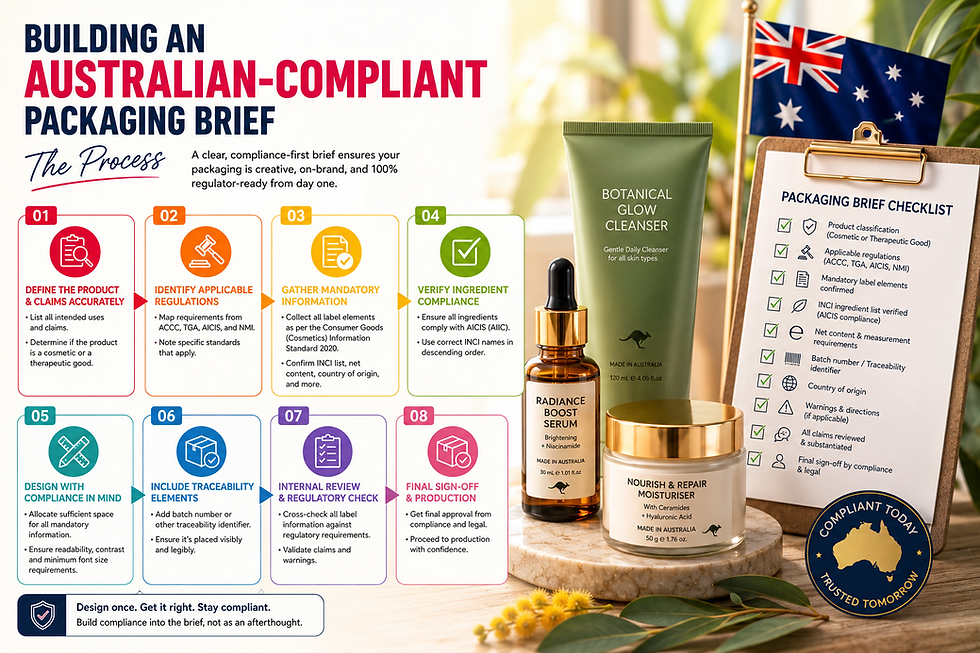
Step 1: Product Classification
Before design begins, determine with certainty whether each product in your range is a cosmetic or a therapeutic good under Australian law. Review every claim you intend to make on pack. If any claim may trigger the therapeutic goods pathway, seek a regulatory assessment before briefing designers.
Step 2: Regulatory Body Mapping
Identify which regulatory bodies apply to your product. Most beauty brands will engage with:
ACCC (Consumer Goods Standard compliance for all products)
AICIS (ingredient compliance, especially for international brands)
TGA (if any product makes therapeutic claims or includes sunscreen)
NMI (net weight accuracy)
Step 3: Label Architecture
Map out every mandatory element and where it will appear on your packaging architecture. Design the label information hierarchy before the visual design begins. This ensures that compliance text is integrated into the design rather than retrofitted onto it.
Panel | Mandatory Information |
Principal Display Panel | Product name, net weight/volume, mandatory front warnings |
Secondary panel(s) | Ingredient list (INCI), supplier address, batch number, expiry/PAO, directions, storage, warnings |
Step 4: Design with Compliance as a Parameter
Brief your packaging designer with the full compliance requirements alongside the brand guidelines. Font size minimums for ingredient lists, space requirements for certification marks, mandatory warning statement lengths, all of these are design parameters. The best packaging designers treat them as constraints to work within creatively, not obstacles to design around inadequately.
Step 5: Pre-Launch Compliance Review
Before final artwork approval, have your packaging reviewed by a compliance specialist against the Consumer Goods (Cosmetics) Information Standard 2020, ACL requirements, and any TGA or AICIS obligations. The cost of this review is a fraction of the cost of a non-compliant product in market.
Step 6: Retailer Requirements
Major Australian retailers, Priceline, Myer, David Jones, Chemist Warehouse, Woolworths and Coles, have their own packaging and compliance submission requirements beyond the regulatory minimums. These vary by retailer and category. Factor retail compliance requirements into your timeline alongside regulatory compliance.
Common Compliance Failures, And the Cost of Each

Compliance Failure | Typical Consequence | Estimated Cost |
Missing or illegible ingredient list | ACCC infringement notice, product withdrawal | $15,000–$50,000+ |
Therapeutic claim without TGA approval | TGA enforcement, mandatory recall | $50,000–$500,000+ |
Incorrect or absent country of origin | ACCC enforcement, label reprint | $10,000–$100,000+ |
Unsubstantiated environmental claim | ACCC infringement notice, corrective advertising | $15,000–$50,000+ |
Missing batch number system | Regulatory exposure in recall event | Varies, potentially catastrophic |
Net weight inaccuracy | NMI infringement notice | $1,000–$10,000 per instance |
Missing PAO symbol on long shelf-life products | ACCC non-compliance | $5,000–$30,000+ |
Using prohibited or non-AIIC ingredients | Product recall, potential import ban | $50,000–$500,000+ |
Costs are indicative ranges based on reported enforcement actions and industry estimates. Actual costs vary by product volume, distribution scale, and the nature of the non-compliance.
How This Applies to International Brands Entering Australia

For beauty brands based in India, the UK, the US, or the UAE planning to enter the Australian market, the compliance pathway has additional steps beyond what a domestic Australian brand faces.
Formulation review against AIIC is required to confirm that every ingredient used is compliant in Australia. Many ingredients approved in major markets, including some approved in the EU or FDA-cleared in the US, are not AIIC-listed.
Importer of record compliance: an Australian entity must accept AICIS registration responsibility. This is typically the Australian distributor. The contractual allocation of compliance responsibility between international brand and Australian distributor must be explicit.
Label adaptation: English language, metric units, Australian supplier address, Australian regulatory marks, all require label adaptation from the international master packaging. This is rarely a cosmetic update. It is a substantive redesign of the packaging information architecture.
Claim review: therapeutic claims that are acceptable in the country of origin may trigger the TGA pathway in Australia. All claims require a specific Australian law review, not just a translation of the original market's compliance assessment.
The most effective approach for international brands is to build Australia-compliant packaging from the same design process, not to adapt non-compliant master packaging after the fact. The time and cost of a compliant label architecture at design stage is a fraction of the cost of a redesign after a retailer or regulator flags non-compliance.
How Suramya Supports Beauty Brands Entering the Australian Market
We work with beauty, skincare, wellness, and personal care brands building packaging for international markets, including the Australian, UK, US, and UAE markets, where regulatory compliance is not optional.
Our packaging process integrates compliance requirements as a design parameter from the first brief. We do not deliver a beautiful design that a compliance consultant then has to retrofit. We build the compliance architecture into the information hierarchy before any visual design begins, ensuring the final packaging is legally sound and brand-strong simultaneously.
For beauty brands preparing an Australian launch, we work through the label architecture, mandatory element placement, and claim copy alongside the visual brand identity, so the compliance review at the end of the process confirms what was designed in, not identifies what must be changed.
Launching a beauty brand in Australia?
Build compliance into your packaging from the very beginning. Talk to Suramya about creating packaging that's designed to meet Australian regulations without compromising your brand.
Frequently Asked Questions
What is the primary law governing cosmetic packaging in Australia?
The primary law is the Consumer Goods (Cosmetics) Information Standard 2020, which is enforced under the Australian Consumer Law (ACL) by the ACCC. This standard applies to all cosmetic products sold in Australia, whether manufactured domestically or imported.
Does my skincare brand need TGA approval to sell in Australia?
If your claims stray into therapeutic territory, the TGA takes over regulatory authority. If your products make only cosmetic claims, hydrating, cleansing, colouring, perfuming, TGA registration is not required. If any product makes therapeutic claims or includes SPF, TGA registration is required before that product can be sold in Australia.
What is AICIS and does my brand need to register?
Businesses must register with AICIS if they import or manufacture cosmetics in Australia. For international brands, this obligation typically falls on the Australian importer. All ingredients must be compliant with the AIIC, the Australian Inventory of Industrial Chemicals.
Are INCI ingredient names mandatory in Australia?
You must use the International Nomenclature of Cosmetic Ingredients (INCI) name or the common English name. Using INCI is highly recommended for clarity and global compliance.
What happens if my product is recalled due to a labelling error?
The costs include product retrieval, retailer penalties, regulatory fines, reprint costs, and reputational damage. Batch numbers play an essential role in traceability and recall processes, allowing companies to efficiently identify and recall only the affected products in case of defects or issues. A functional batch number system limits the scope of a recall. An absent one requires a full market withdrawal.
Can I use "natural" or "clean" on my Australian packaging? These terms are not legally defined in Australia but are subject to the ACCC's prohibition on misleading conduct. Any claim, including "natural" or "clean", must be substantiated by evidence that the claim is accurate. The ACCC has pursued enforcement actions against brands making unsubstantiated natural and environmental claims.
Related reading:
→ Packaging design services [suramya.co/packaging-design-services]
→ Beauty brand identity design [suramya.co/beauty-branding]
→ Skincare brand design [suramya.co/skincare-branding]
Suramya is a brand identity and packaging design studio working with consumer brands, CPG startups and founder-led beauty and wellness businesses across India, the UAE, the US, the UK and Australia.



Comments