


Why Most First-Time Brands Get Rejected on Blinkit And How to Get Approved

Quick commerce is no longer a channel Indian FMCG and D2C brands can ignore.
Blinkit, currently holding the largest share of India's quick commerce market, delivers across 25+ cities and growing. For an FMCG startup or D2C brand looking to reach urban consumers at the moment of intent late at night, mid-recipe, on an impulse Blinkit is the most valuable retail channel in India right now.
But Blinkit is not an open marketplace. It is a curated platform with a selective onboarding process. And most first-time brands that apply fail not because their product is wrong but because their application, documentation or packaging is.
This guide covers everything a first-time Indian brand needs to know to successfully onboard onto Blinkit in 2026 from eligibility and documents to the approval process, the Category Manager evaluation, and the packaging requirements that determine whether your stock gets accepted at the dark store.
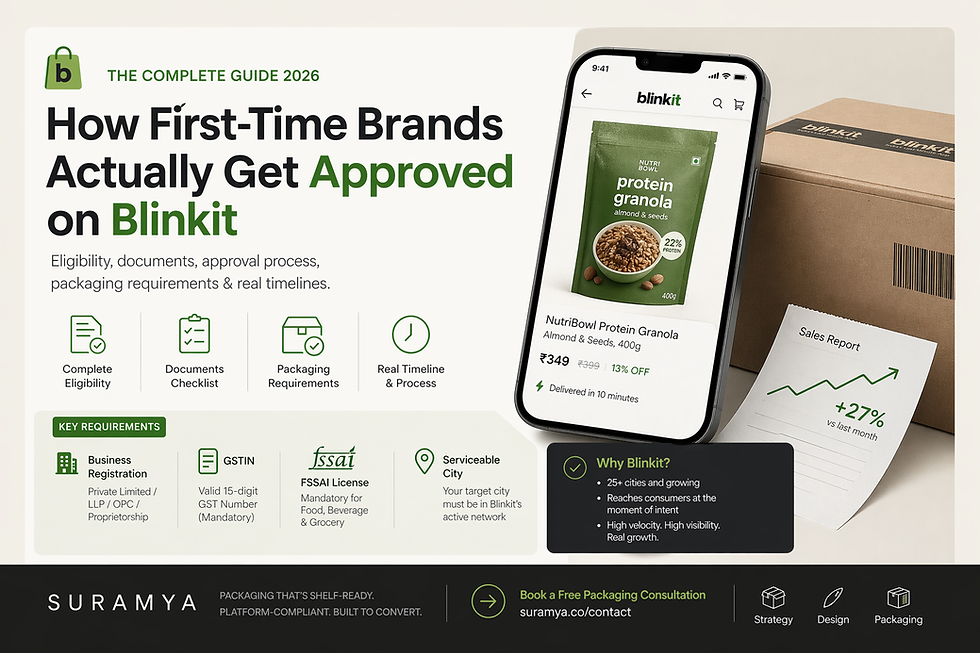
Can a First-Time Brand Actually Sell on Blinkit?
Yes. But with important caveats.
Blinkit accepts first-time brand owners and D2C brands. There is no minimum sales history requirement. There is no requirement to have existing listings on Amazon or Flipkart before applying though having them strengthens your application.
What Blinkit requires is product-market fit, documentation completeness, pricing viability and packaging compliance. All of these are within a first-time brand's control.
The platform is selective because it operates a dark store model, each store has finite physical space and each category slot has a finite number of brands. When Blinkit lists your product, they are making a commercial bet. Their Category Manager has a stake in your product performing. That is actually an advantage once you are in but it makes the entry criteria genuinely competitive.
The brands that get approved are not always the largest or most established. They are the most prepared.
Blinkit Eligibility — Who Qualifies as a Seller
Blinkit recognises four types of sellers on its platform. First-time brands typically fall under brand owner or D2C brand.
Manufacturers — brands with direct production capability
Brand owners — trademark registered or application in process
Authorised distributors — with a brand letter from the parent brand D2C brands meeting documentation and compliance requirements
All four are eligible. The requirements differ slightly by category.
The Three Non-Negotiable Baseline Requirements
Before anything else three things must be in place:
Requirement | Detail |
Business Registration | Private Limited (preferred), LLP, OPC or proprietorship |
Valid GSTIN | Mandatory — 15-digit number |
Serviceable city | Your target city must be in Blinkit's active network |
For food, beverage, grocery and health categories an FSSAI licence is mandatory in addition to the above. This applies to the majority of FMCG categories on the platform. If your product falls into any of these categories and you do not have FSSAI registration get it before beginning your Blinkit application.
What Strengthens a First-Time Brand's Application
A trademark or TM application in process significantly improves approval likelihood. Blinkit's legal team runs its own assessment alongside the commercial evaluation. A trademark reduces perceived risk and speeds up legal clearance.
Existing listings on Amazon or Flipkart are not mandatory but they give the Category Manager reference data on pricing, demand and positioning. Without them, approval relies more on the CM's judgment with less supporting evidence.
A functional brand website signals that the brand is operationally real and customer-facing, not just a product in search of a distribution channel.

What Blinkit Actually Evaluates Before Approving a Brand
Most first-time brands assume Blinkit's approval is primarily a documentation process. It is not. The documentation is the entry requirement. The actual evaluation is commercial and operational.
Product-Market Fit
Does your product solve a clear, specific need? Is the format, size and price point aligned with what quick commerce consumers in your target cities are already buying in your category?
Blinkit's Category Managers have access to platform search and purchase data for every category in every city cluster. They can see whether there is existing consumer demand for your product type before your stock arrives. A product that fills a real gap in the category has a significantly stronger approval path than one entering an already saturated segment.
Category Demand in Your Target Cities
Even an excellent product will struggle to get approved if the category has low search and purchase velocity in the specific cities you are targeting. Blinkit operates hyperlocally demand patterns in Mumbai can be completely different from those in Noida or Bangalore.
If you are targeting multiple cities, prioritise the 2–3 where your category has the strongest demand signal. Approval in one city cluster creates a reference point that accelerates approval in others.
Margin Viability
Blinkit's commission structure sits at 8–15% of MRP, plus 18% GST on the commission. Your MRP must cover this commission, your cost of goods, logistics to the dark store, and the cost of the ₹25,000 per SKU per cluster PLA fee while still being priced competitively against alternatives on the platform.
This is where many first-time brands' applications stall. The maths simply do not work at the MRP they have set. There is no workaround here if the pricing model is not viable, approval is not possible regardless of how strong everything else is.
Run your numbers before applying. Calculate: MRP minus Blinkit commission minus logistics cost minus COGS. The margin remaining must be sufficient to sustain operations and absorb the PLA cost over time.
Packaging Quality and Compliance
This is where a first-time brand's preparation or lack of it becomes most visible. And it is where Suramya's perspective is most directly relevant.
Blinkit evaluates packaging at two stages. First during the Category Manager's commercial review where packaging quality signals brand credibility and thumbnail performance predicts consumer conversion. And second at the dark store inward check where physical compliance is verified before stock is accepted.
Packaging that fails either stage costs you time, money and potentially your listing.
We will cover this in detail below.
The Category Manager — The Real Gatekeeper
Once your initial registration is submitted and reviewed typically within 7–15 days, Blinkit assigns a Category Manager. This is the person who determines whether your brand proceeds or stalls indefinitely.
The Category Manager evaluates:
Thumbnail performance : how your product looks on a 5-inch screen when displayed at app thumbnail size. This is not the same as how it looks in a product photography studio. It requires specific design decisions about contrast, label clarity and visual hierarchy that are different from packaging designed for physical retail.
Shelf life viability : quick commerce dark stores operate on rapid turnover. Products with shelf lives under 90 days face stricter scrutiny. Perishable products require clear shelf-life documentation and a supply chain that can support frequent small replenishments.
Inventory readiness : the Category Manager needs confidence that you can reliably replenish dark store stock on a consistent cycle. A first-time brand that cannot demonstrate supply chain readiness will struggle to hold onto its listing even after initial approval.
Competitive pricing : your MRP must allow Blinkit to run the promotions and discounts they use to drive category velocity. If there is no headroom in your pricing for a 10–15% promotional discount : you cannot participate in the campaigns that drive visibility on the platform.
Your responsiveness — this is rarely stated explicitly but consistently reported by brands who have navigated the process. Category Managers work across dozens of brands simultaneously. Brands that respond promptly, provide requested information clearly and follow up appropriately get prioritised. Brands that go quiet or are slow to respond get deprioritised sometimes indefinitely.
The SOR vs OR Model — Which Applies to First-Time Brands
Blinkit operates two commercial models for supplying stock to dark stores.
SOR - Sale or Return This is the standard model for first-time brands.
Blinkit takes your products into their dark stores and attempts to sell them. Unsold stock is returned to you. You pay a PLA (Product Listing Advertisement) fee of ₹25,000 per SKU per city cluster which converts entirely into advertising credit on Blinkit's platform.
The ₹25,000 is not a non-refundable listing fee. It becomes ad spend that drives visibility for your product within the app. But it does require upfront cash readiness per SKU per market you are entering.
OR - Outright Purchase Blinkit raises a formal Purchase Order and buys your stock outright. This model is generally reserved for established brands with demonstrated demand.
For a first-time brand SOR is the path in. Plan for the PLA cost in your launch budget.
Documents Required for Blinkit Onboarding (2026)
Missing or incorrect documentation is the most common reason first-time brand applications stall or get rejected outright.
Mandatory Documents
Document | Notes |
GST Certificate (GSTIN) | 15-digit number — must match all other documents exactly |
PAN Card | Business PAN preferred, personal PAN for sole proprietorship |
Bank Account Details | Cancelled cheque or bank passbook first page |
Business Registration Certificate | Certificate of Incorporation, LLP deed or proprietorship registration |
Identity Proof | Aadhaar card, Passport or Driver's Licence |
Category-Specific Documents
Category | Additional Requirement |
Food, beverages, grocery | FSSAI Licence (State or Central based on turnover) |
Skincare and cosmetics | COS-8 or COS-9 licence for manufacturers |
Branded products | Trademark Certificate or TM application number |
Imported goods | Import Export Code (IEC) |
Supporting Documents That Accelerate Approval
Product catalogue with MRP, description, shelf life and weight per unit
High-resolution product images on white background
Product links from existing Amazon or Flipkart listings
Brand website URL
EAN barcodes for every SKU
One practical note: all documents should be in PDF format, clearly named and well-scanned. Blurry uploads and name mismatches between your GST certificate and bank documents are among the most common operational reasons applications stall at the verification stage.
Step-by-Step Blinkit Onboarding Process for First-Time Brands
Step 1 - Register on the Blinkit Seller Portal Go to seller.blinkit.com. Create your account with your business email. Verify via OTP. Select your selling category and enter your business details.
Step 2 - GSTIN Verification Enter your 15-digit GSTIN. Blinkit auto-fetches your business information from the GST database. Confirm it matches your other documents exactly any mismatch restarts the verification.
Step 3 - Brand and Product Details Add your brand name, category and product description. This is your first commercial impression with the Category team be specific, accurate and professional.
Step 4 - KYC and Bank Details Upload your KYC documents and enter bank account details. This sets up your payout structure.
Step 5 - Category Manager Assignment After initial submission review typically 7–15 days a Category Manager is assigned. Follow up proactively. Applications that go quiet at this stage can stall for months without follow-up.
Step 6 - Product Listing Upload SKUs in Blinkit's required format product name, description, weight, shelf life, MRP, EAN barcode and compliant images. Every SKU goes through a compliance check before proceeding.
Step 7 : PLA Payment and Commercial Agreement Under SOR, pay the ₹25,000 per SKU per cluster PLA fee. Sign the Vendor Master Agreement covering commission rates, payment terms and returns policy.
Step 8 : Stock Dispatch to Dark Store Once listings are cleared and the PO is raised — dispatch stock to the designated dark store. Your products go live after the inward team's physical check.
Realistic Blinkit Onboarding Timeline
Stage | Typical Duration |
Portal registration and GSTIN verification | 1–2 days |
Document submission and review | 3–7 days |
Category Manager assignment | 7–15 days |
Product listing and compliance check | 5–10 days |
PLA payment and agreement | 2–5 days |
Internal review post-listing | 7–15 days |
First PO and dispatch | 5–10 days |
Total end-to-end | 30–60 working days |
Plan for 8 weeks from application to first sale as a realistic baseline. Have inventory ready. Have your cash flow modelled for the PLA cost. And follow up consistently with your Category Manager throughout brands that stay visible in the process move faster.

Why Packaging Is the Single Most Critical Variable on Blinkit
This is where we speak from direct experience.
Blinkit is fundamentally a visual commerce platform. Every consumer decision happens on a 5-inch screen. There is no physical browsing, no shelf presence, no in-store discovery. Your product thumbnail is your entire shelf.
This means packaging for Blinkit is not the same as packaging for a supermarket shelf, a pharmacy shelf or a direct-to-consumer shipment. It has specific requirements and brands that ignore them either fail the inward check at the dark store, or pass the check and then fail to convert on the platform.
What Blinkit's Inward Team Checks at the Dark Store
Once your stock arrives at the dark store these checks determine whether it is accepted:
EAN barcode scan must scan correctly. If the barcode fails, the entire consignment is rejected at the gate. No exceptions.
MRP printed on packaging must be printed directly on the packaging, not just on a removable sticker. Stickers fall off during storage and picking. A product without a visible MRP fails the inward check.
Shelf life on arrival typically at least 60–70% of total shelf life must remain at the point of inward. A product with a 12-month shelf life must arrive with at least 7–8 months remaining.
Label compliance FSSAI number, nutritional information, manufacturing details, net weight all mandatory content must be present, legible and correctly formatted.
What Blinkit's Algorithm Evaluates After Listing
Passing the inward check gets your product onto the platform. Converting on the platform requires something different thumbnail design.
At thumbnail size, the visual hierarchy rules that apply to physical retail packaging change entirely. High contrast between background and product is more important than in-store. Brand name legibility at small scale becomes the primary design priority. Product imagery must communicate what the product is within a fraction of a second.
Packaging designed for a modern trade shelf with detailed front panel information, complex visual layouts and multiple focal points typically performs poorly as a quick commerce thumbnail. The information hierarchy that works at arm's reach on a shelf becomes visual noise on a phone screen.
The Packaging Brief for Blinkit — What to Tell Your Designer
If you are designing packaging with Blinkit in mind brief your packaging agency specifically on:
Thumbnail test first — the front panel design should be evaluated at actual thumbnail size on a phone screen before any other assessment.
High contrast as a non-negotiable — the brand name and product descriptor must be readable at thumbnail size against the background colour. Test in greyscale.
Single dominant visual element — one hero image or graphic device that communicates the product instantly at small scale. Multiple visual elements that work at full size become indistinguishable at thumbnail size.
Regulatory content placement — all mandatory FSSAI and regulatory content must be present on the label but should be placed and sized in a way that does not compromise thumbnail performance.
Barcode placement — EAN barcodes must be accessible and scannable. Brief your designer on barcode size and placement requirements for dark store inward acceptance.
At Suramya, every packaging project we work on with FMCG and D2C brands now includes a thumbnail performance check as a standard deliverable — because quick commerce has made this a baseline requirement, not an optional consideration.
Common Reasons First-Time Brands Get Rejected on Blinkit
Incomplete or mismatched documentation — name discrepancies between GST and bank documents, missing FSSAI licence, blurry uploads. These cause rejection at the verification stage before anyone ever evaluates your product.
Non-compliant product images — Blinkit requires high-resolution images on a white background with no text overlays on the primary image. Non-compliant images fail the catalog check.
Pricing that does not support Blinkit's commission structure — if the maths do not work after factoring in commission, logistics and PLA cost, approval is impossible regardless of product quality.
Missing or invalid EAN barcodes — products without valid EAN codes cannot be listed. GS1 India is the authoritative source for barcodes in India.
Packaging failing the inward check — MRP stickers that fall off, barcodes that do not scan, missing FSSAI numbers, insufficient shelf life. These are discovered at the dark store and result in stock being returned to the brand.
No follow-up with the Category Manager — applications that go quiet after initial submission routinely stall for months.
The Brand Advantage of Getting Into Blinkit Early
India's quick commerce market is growing at extraordinary speed. The brands that establish themselves on Blinkit now building sales velocity, review count and platform algorithm authority will be significantly harder to displace in 12–18 months.
For a first-time Indian brand, Blinkit is not just a sales channel. It is a proof-of-concept platform. Sales velocity on Blinkit creates data that strengthens your position with modern trade buyers, supports fundraising conversations and builds the consumer base that drives direct purchase.
Getting in requires preparation. But for brands that prepare the upside is disproportionate.
Ready to Get Your Brand and Packaging Blinkit-Ready?
At Suramya we work with FMCG, wellness and lifestyle brands across India on packaging that passes Blinkit's inward check, performs at thumbnail scale and communicates brand quality at first glance.
If you are planning a Blinkit launch and want packaging that will not get rejected at the dark store book a free packaging consultation and we will tell you exactly what needs to be in place before your stock leaves your warehouse.
[Book a Free Packaging Consultation → suramya.co/contact]
FAQs — Selling on Blinkit as a First-Time Brand
Q: Can a brand with no prior sales history sell on Blinkit?
A: Yes. Blinkit has no minimum sales track record requirement for brand owners and D2C brands. A trademark (or TM application in process) significantly improves approval likelihood.
Q: What is the PLA fee on Blinkit and is it refundable?
A: The PLA (Product Listing Advertisement) fee is ₹25,000 per SKU per city cluster. It is not a non-refundable fee it converts entirely into advertising credit on Blinkit's platform. It does require upfront cash readiness.
Q: How long does Blinkit onboarding take for a new brand?
A: Plan for 30-60 working days end-to-end. Having complete documentation ready upfront, compliant product images and a trademark in place significantly reduces this timeline.
Q: What packaging requirements does Blinkit have?
A: MRP must be printed on the packaging (not just a sticker). EAN barcodes must scan correctly. FSSAI number and all regulatory content must be present and legible. Shelf life at the time of inward must meet the platform's minimum threshold typically 60–70% of total shelf life remaining.
Q: Do I need an FSSAI licence to sell food products on Blinkit?
A: Yes. FSSAI registration is mandatory for all food, beverage and grocery products on Blinkit. Apply for your FSSAI licence before beginning your Blinkit application if you are in any of these categories.
Q: What is the difference between SOR and OR on Blinkit?
A: SOR (Sale or Return) is the standard model for new brands Blinkit takes your stock, sells what it can, and returns unsold inventory. OR (Outright) is where Blinkit raises a Purchase Order and buys your stock this is generally reserved for established brands with proven demand.
Related reading:
→ Packaging design for FMCG brands [suramya.co/fmcg]
→ D2C packaging design India [suramya.co/packaging-design]
→ Creative packaging ideas for Indian brands [suramya.co/blog]
Suramya is a brand identity and packaging design studio based in Noida, India. Over 7 years and 250+ projects, we have helped FMCG and D2C brands across India build packaging that is shelf-ready, platform-compliant and built to convert.


Comments